Voice AI: What It Is, How It Works, and Why Businesses Are Deploying It in 2026
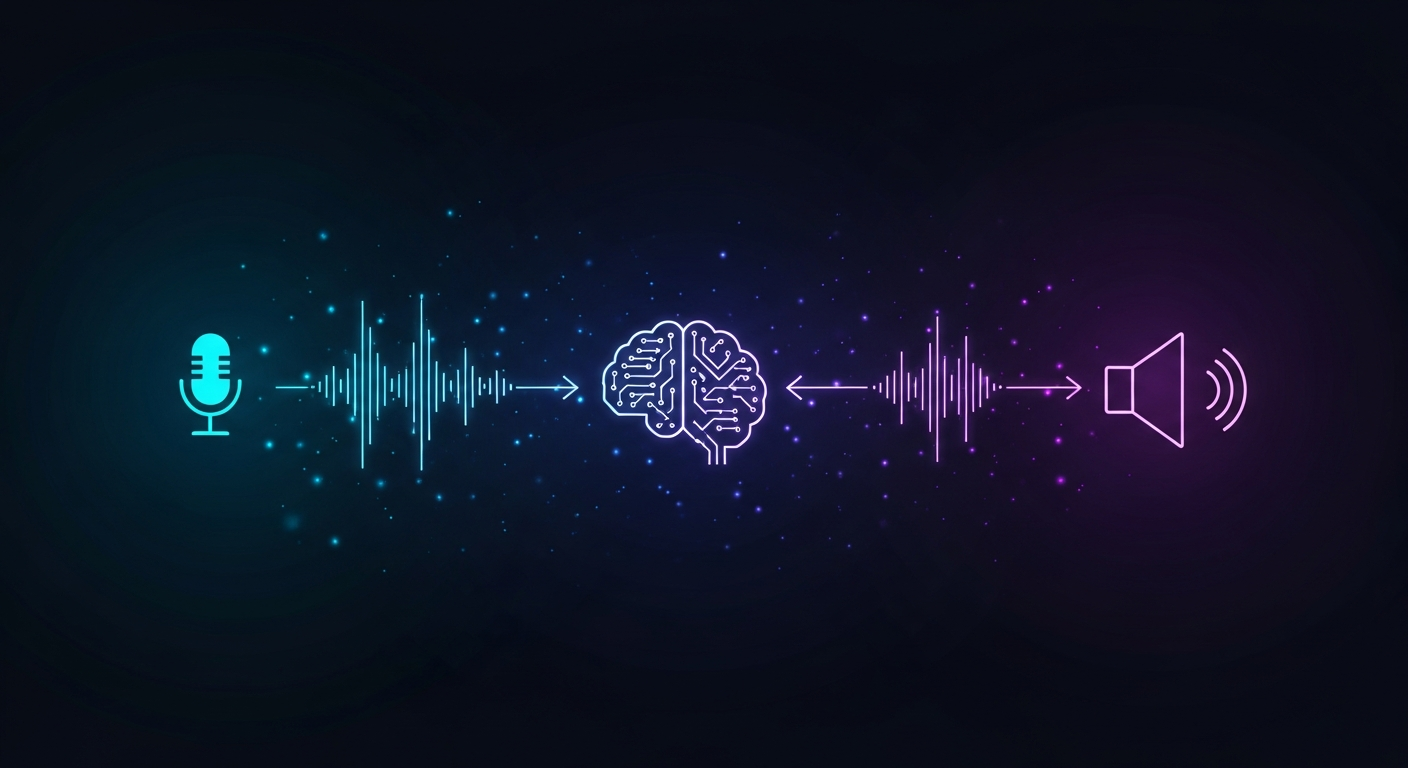
Voice AI is software that understands spoken language, processes the meaning behind it, and responds — either in speech or by triggering an action — without a human operator. In a customer service context, it means a customer calls a number, speaks naturally, and gets a useful response in seconds: answers to questions, booking confirmations, order updates, complaint resolution. No menu trees. No "press 1 for billing." Businesses are deploying voice AI because the alternative — staffing phone lines adequately — has become economically unsustainable, and because customers who call rather than type expect immediate service, not a queue.
The term covers a spectrum of capability. At one end, basic voice AI recognises a limited set of commands and routes calls accordingly — more sophisticated than a DTMF menu, but still constrained. At the other end, modern voice AI agents conduct full conversations: they understand context across multiple turns, handle interruptions, manage ambiguity, and complete tasks like booking appointments or processing refunds.
The core functions in a business deployment:
Inbound call handling — the voice AI answers calls, identifies the customer (often by phone number or a spoken account reference), understands what they need, and either resolves the issue or routes to the right human with full context already captured.
Outbound calling — proactive calls for appointment reminders, payment nudges, delivery notifications, or re-engagement sequences. Voice outreach at scale without a dialler team.
Voice-based authentication — verifying customer identity through voice patterns or spoken PINs before proceeding with account-sensitive requests.
Voicemail and missed-call recovery — automatically transcribing voicemails, classifying intent, and triggering follow-up — so no inquiry goes unanswered simply because a customer called out of hours.
Real-time agent assist — voice AI running in the background of a human agent call, transcribing in real time and surfacing relevant information, suggested responses, or compliance prompts on the agent's screen.
The Technology Behind Voice AI
Understanding how it works helps set realistic expectations about what it can and can't handle.
Automatic Speech Recognition (ASR) converts spoken audio into text. This is the step where accents, background noise, and speech pace most affect accuracy. Modern ASR engines trained on diverse speech data handle casual, accented, and noisy audio far better than systems from five years ago, but quality still varies significantly between providers.
Natural Language Understanding (NLU) interprets the transcribed text to identify intent — what the caller wants — and extract entities — the specific account number, date, product name, or location they mentioned. NLU is where the difference between "I want to check my order" and "has my package shipped yet?" gets resolved to the same intent.
Dialogue management handles the conversation flow — tracking what's been established, deciding what to ask next, managing clarification when something was unclear, and determining when the conversation is complete or needs escalation.
Text-to-Speech (TTS) converts the AI's response back into spoken audio. TTS quality has improved dramatically; the best engines produce speech that most callers cannot readily distinguish from a human voice at a normal conversation pace.
Backend integrations are what make voice AI useful rather than just impressive in a demo. The AI needs to query real systems — order management, booking calendars, account databases, payment processors — to do anything more than answer general questions.
The quality of each layer compounds. Strong NLU sitting on weak ASR produces misunderstandings the AI can't recover from. Excellent dialogue management connected to unreliable integrations produces confident wrong answers. Every layer needs to work.
Where Voice AI Delivers the Most Value
Not every business has a strong use case for voice AI. The clearest signals that it makes sense:
High inbound call volume with predictable query types. If your call centre handles thousands of calls per week and the majority fall into categories like order status, appointment booking, billing queries, and general FAQs, voice AI can handle a significant proportion without human involvement. The higher the volume and the more predictable the mix, the stronger the ROI case.
After-hours call coverage. Businesses that lose calls outside operating hours — and most do — can recover that volume with voice AI without shift premiums. For sectors like healthcare, real estate, and home services, where inquiry timing is unpredictable, this matters.
Outbound notification programmes. Running manual outbound call campaigns for appointment reminders or payment reminders is labour-intensive. Voice AI handles these at scale, with human-quality speech, at a fraction of the cost.
Multilingual markets. A business serving customers across multiple language communities cannot staff separate teams for each language cost-effectively. Voice AI trained across languages covers the full linguistic footprint without proportional headcount growth.
High agent turnover environments. Contact centres with high staff turnover spend disproportionately on recruiting and training. Voice AI absorbs the high-volume, low-complexity calls that new agents struggle with, protecting customer experience from training gaps.
Where Voice AI Falls Short
Voice AI has genuine limits that are worth naming before a deployment decision.
Complex or emotionally charged conversations do not belong with an AI system. A customer calling about a billing dispute involving a significant amount, a complaint about a service failure that affected them seriously, or any situation where empathy and judgment are the primary requirements — these need a human. Voice AI that tries to handle these conversations and fails damages trust more than having no AI at all.
Highly variable or unpredictable queries. Voice AI works best when the domain is bounded — the topics it might be asked about are knowable in advance and have knowable answers. Businesses where customers could ask about almost anything, or where the answers require real-time judgment calls, need a tighter human-involvement model.
Accents and dialects it wasn't trained on. ASR accuracy drops for accents and speech patterns underrepresented in the training data. A voice AI system trained primarily on American English will struggle with Gulf Arabic code-switching, regional South Asian accents, or informal Khaleeji speech patterns. Deploying in a market without verifying dialect handling is one of the most common causes of poor voice AI performance outside Western markets.
Legal and regulatory constraints. In some markets and sectors, AI-handling of certain conversation types (financial advice, medical guidance, legal matters) is regulated or restricted. Compliance requirements need to be mapped before deployment, not after.
Voice AI in the MENA Region: Specific Considerations
Deploying voice AI in Gulf markets involves challenges that are largely invisible to vendors building for Western markets.
Dialect complexity is the primary one. Arabic is not a single spoken language. Gulf Arabic (Khaleeji), Egyptian, Levantine, and Moroccan dialects differ enough that a system trained on one performs poorly on another. Customers in Saudi Arabia, the UAE, and Oman speak differently, and a voice AI that handles one market's speech patterns confidently may confuse another. Verifying that an ASR model was trained on the specific dialects your customers use is not optional — it determines whether the system works at all.
Code-switching is the norm, not the exception, for younger urban callers in MENA. Conversations mix Arabic and English mid-sentence in ways that are grammatically natural to the speaker but challenging for systems that handle each language separately. Voice AI that treats code-switching as an error rather than normal speech will misclassify a significant share of real calls.
WhatsApp voice notes represent a related but distinct opportunity. MENA customers frequently communicate with businesses through WhatsApp voice messages rather than phone calls. AI that can transcribe, interpret, and respond to voice messages in the WhatsApp environment serves a channel that a traditional voice AI deployment — phone-first — misses entirely.
What Voice AI Implementation Looks Like in Practice
Most businesses go through a recognisable set of phases.
Scoping and use case selection — analysing call data (volumes, categories, resolution patterns, average handling time) to identify which call types are best suited for initial automation. Starting with a single, high-volume, well-defined use case produces faster results than trying to automate everything at once.
System design and dialogue scripting — mapping the conversation flows the AI will need to handle, including the edge cases, interruptions, and recovery paths when something goes wrong. This step is often underestimated; a realistic dialogue map for even a single use case is more complex than it looks on a whiteboard.
ASR and NLU training — configuring the AI with the vocabulary, entity types, and speech patterns specific to your business and customer base. Off-the-shelf models need adaptation to handle industry terminology, product names, and regional language patterns accurately.
Integration development — connecting the voice AI to the backend systems it needs to complete tasks. This is frequently the longest part of implementation and the most likely to cause delays when system documentation is incomplete or APIs are poorly maintained.
Testing — testing with real speech, not just typed test cases. ASR performance on synthetic input does not predict ASR performance on real customer calls. A testing phase with actual callers (internal team or a controlled beta group) surfaces errors that lab testing misses.
Deployment and monitoring — going live with active monitoring of accuracy, escalation rates, and customer sentiment. Voice AI performance is not static; it requires ongoing refinement as call patterns evolve and edge cases accumulate.
Timeline for a well-scoped voice AI deployment: 8–16 weeks from decision to live, depending on integration complexity and the number of initial use cases.
Evaluating Voice AI Vendors
The questions that matter most when assessing voice AI companies:
Which languages and dialects does the ASR model actually support, and what are the accuracy benchmarks for your market? Ask for test results on audio samples representative of your actual callers. General language support claims are not the same as dialect-specific accuracy.
What does the integration layer look like? Pre-built connectors to common platforms reduce implementation time. Custom API development is possible but adds cost and timeline.
How does escalation to a human work? What triggers it, what context transfers, how fast can a human take over? A voice AI with a poor escalation design frustrates callers more than it helps them.
What does the ongoing management model require? Can your team update call flows and add new use cases without vendor involvement? How is the model retrained as call patterns change?
What are the data handling and residency policies? For businesses in regulated markets, or those with enterprise security requirements, where voice data is processed and stored is a substantive concern.
Common Questions About Voice AI
Do callers know when they're talking to AI? In most deployments, disclosure is standard practice. Many customers accept AI handling routine requests without objection; what causes friction is discovering they've been talking to AI after assuming they were speaking with a human. Transparent disclosure upfront avoids this.
How accurate does voice AI need to be before it's viable? ASR accuracy in the mid-90% range for your specific call type and dialect is typically the threshold for acceptable customer experience. Below that, the frequency of misunderstandings creates more frustration than the speed benefit is worth.
Can voice AI handle emotional or upset customers? It can detect sentiment signals — tone, speech pace, keyword patterns — and use them to trigger faster escalation. Handling an upset caller well, however, requires human judgment. Voice AI is a tool for routing, not for managing emotional conversations.
What happens when the AI doesn't understand the caller? The AI should ask for clarification naturally — "I didn't quite catch that, could you say that again?" — and after a defined number of failed attempts, escalate to a human with a warm handover rather than abandoning the caller in a loop.
The Bottom Line
Voice AI has crossed the threshold from impressive to practical for businesses with meaningful inbound call volume or outbound communication needs. The technology works when it is deployed to the right use cases, trained on the right speech data, and connected to real backend systems.
The gap between voice AI that works and voice AI that frustrates callers is mostly a function of preparation — scoping the right use cases, verifying dialect coverage, and building clean escalation paths — not a function of the underlying technology being insufficient.
For businesses in MENA markets, the dialect and code-switching question is the most consequential deployment decision. A system that handles standard English well but misunderstands Gulf Arabic speech patterns will fail on a large proportion of real calls, regardless of how well it performs on everything else.
Orki's AI agents handle voice and text interactions across WhatsApp, Instagram, and the web — in Arabic, Khaleeji, English, and Urdu, built for how MENA customers actually communicate. Learn more at orki.ai.
Ready to transform your business?
See how Orki's AI agents work for your industry
Try Orki Free