Conversational AI for Ecommerce: From Product Discovery to Post-Purchase Support
Conversational AI for ecommerce means using AI-powered chat to handle every part of the customer's shopping journey — from the first "what's the difference between these two?" to the post-delivery "I want to return this." The goal is to make every step of the journey feel like talking to someone who knows the product, knows the customer, and can act on their behalf immediately. The distinction from basic ecommerce chatbots is worth making. A chatbot answers preset questions. Conversational AI conducts actual back-and-forth dialogue — it understands what the customer means, remembers what was said earlier in the conversation, asks sensible clarifying questions, and responds differently based on context. Customers interact with it the way they'd interact with a helpful shop assistant, not the way they navigate a phone menu.
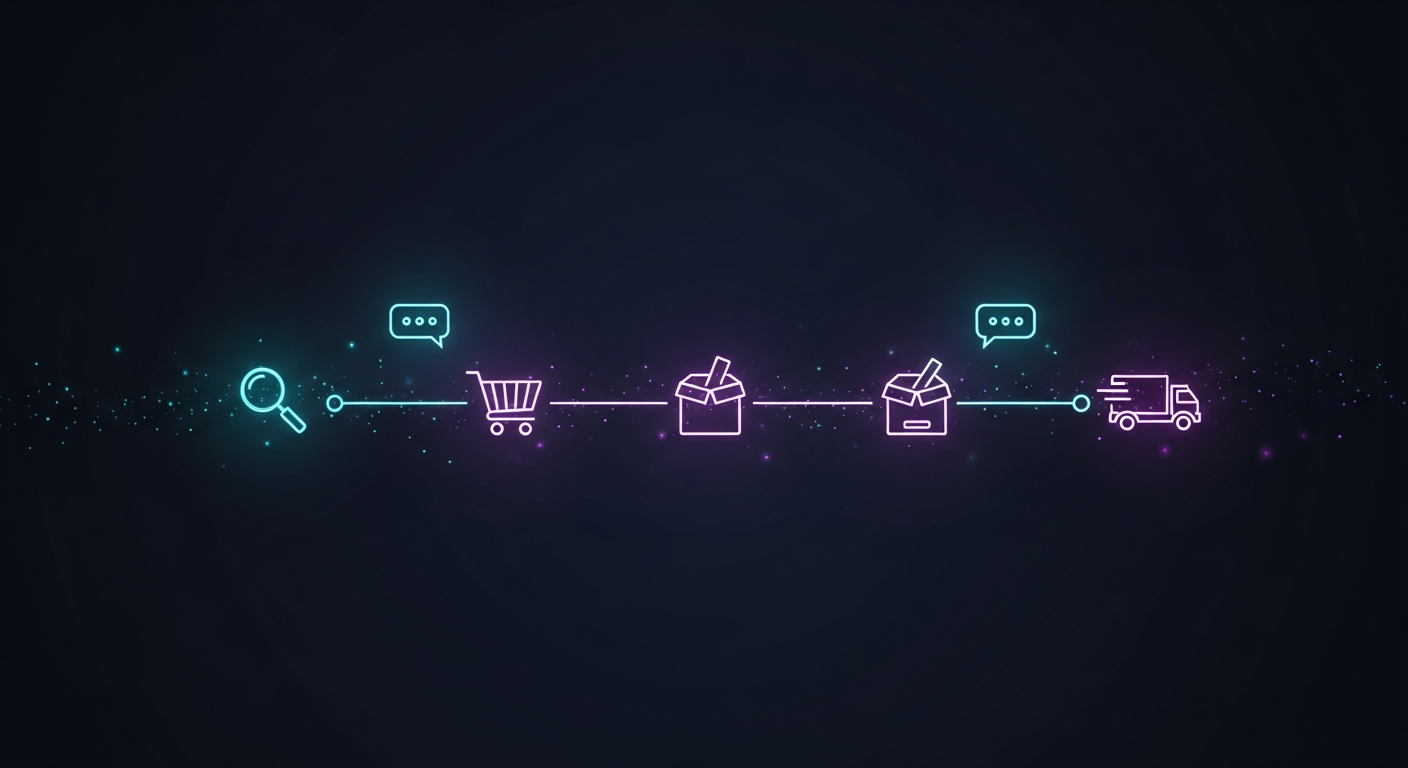
The shopping journey has several friction points where conversational AI produces measurably better outcomes than no assistance at all.
Product discovery and selection. Customers browsing a product catalogue often get stuck when they have questions that the product page doesn't answer: which of these two options is better for my use case, does this come in a specific size, will this fit my existing setup. Without an immediate answer, a significant portion of those customers leave. A conversational AI that handles these questions in real time — drawing from the full product knowledge base, asking clarifying questions when the customer's use case is ambiguous — converts browsers into buyers.
Pre-purchase anxiety reduction. Customers about to make a purchase, particularly a larger one, have doubts: about delivery time, return policy, quality, compatibility, whether this is the right choice. Conversational AI that addresses these doubts immediately and accurately — without requiring the customer to leave the product page and navigate to an FAQ — removes the last barrier between interest and transaction.
Cart abandonment recovery. A customer who adds items to a cart and then stops is not necessarily lost. They may have had a question they couldn't easily answer, encountered a friction point in the checkout, or simply got distracted. Conversational AI can identify this signal and proactively reach out — on WhatsApp, if the customer has opted in — with a relevant message: "You left something behind. Is there anything we can help with?" Some percentage of those conversations will re-engage the customer and complete the sale.
Order management and tracking. The volume of "where is my order?" contacts is high in every ecommerce operation, and the answer is almost always automatable: the AI queries the OMS in real time, retrieves the order status, and responds instantly. This single use case often accounts for 30–40% of total ecommerce support volume and can be fully handled by conversational AI with a simple OMS integration.
Returns and exchanges. Returns are structurally similar to order tracking — they involve structured questions with structured answers (is this item eligible for return, what's the process, how long does the refund take) — and they can be initiated and processed through a conversational flow. The customer doesn't need to wait for an email or call a number; they describe the situation in chat and the AI walks them through the process.
Post-purchase engagement. After delivery, an AI can check in on the purchase, surface relevant complementary products, remind customers of loyalty points or upcoming promotions, and ask for feedback. When this is done in a conversational format rather than a mass email, the response rate is higher and the data quality better.
How Conversational AI Understands Ecommerce Intent
The natural language understanding (NLU) layer in an ecommerce conversational AI needs to handle several categories of intent that are specific to commerce contexts.
Product intent — the customer wants to know about a specific product, compare products, or find a product that meets their criteria. The AI needs to map their natural language question ("I need something for a 10-year-old who likes outdoor activities, budget around 200") to the right product category and specific recommendations.
Transactional intent — the customer wants to do something: place an order, check an order, change an order, return a product, apply a discount code, update delivery details. Each of these requires a different action from the AI, and some require backend system calls to complete.
Informational intent — the customer wants to know something about policies, processes, or general brand information: return windows, warranty terms, delivery zones, payment methods. These are handled through the knowledge base.
Complaint and escalation intent — the customer is unhappy about something and may be expressing it more or less directly. The AI needs to recognise this, respond with appropriate empathy, and either resolve the issue or escalate to a human depending on the severity and the AI's ability to address it.
Ecommerce conversational AI performs best when trained on real customer language from real ecommerce interactions — not generic conversation data, but the specific ways customers in a given market and category express these intents. The gap between generic NLU and domain-specific NLU is visible in production performance.
Conversational Commerce on WhatsApp
For ecommerce businesses in MENA markets, WhatsApp is not a channel to consider adding — it is the channel to build the primary commerce experience around.
WhatsApp's commerce features make the full purchase journey possible within a conversation:
Product catalogues can be shared directly in chat. A customer who asks "do you have anything in blue in size medium?" can be sent a filtered view of available products without leaving WhatsApp.
Order placement can happen within a conversation. Conversational AI walks the customer through selection, confirms details, and processes the order — or sends them a payment link — within the same exchange.
Payment links allow customers to complete payment and return to the conversation without switching apps. For markets where in-app payment is not available, this keeps friction minimal.
Delivery updates are sent proactively as the order progresses. The customer's conversation thread becomes their order tracking interface — not a separate app or an email they may have missed.
Returns and post-purchase continue in the same thread, with the AI having full context of every previous interaction.
The result is an ecommerce experience that feels genuinely frictionless because the customer never has to leave their messaging app, navigate a website, or find an account login.
This matters disproportionately in MENA because the region's ecommerce market is WhatsApp-native in a way that Western markets are not. Customers expect brands to be reachable there; brands that are not present with a capable AI are leaving a substantial share of interaction volume unserved.
Personalisation in Conversational Ecommerce
The difference between a useful conversational AI and a great one in ecommerce is personalisation — whether the AI treats each customer as an individual with a history rather than as an anonymous visitor.
Purchase history awareness. A customer who has bought a particular product category three times gets recommendations that reflect that preference, not generic bestseller suggestions.
Size and preference memory. A returning customer shouldn't have to re-enter their size, preferred delivery address, or usual payment method. The AI should remember and use it.
Stage-appropriate conversation. A new customer gets more explanatory context. A loyal customer who asks a question gets a faster, less hand-holdy answer. The conversation style should match what the AI knows about the relationship.
Timing awareness. A recommendation sent the day after delivery of a product ("how are you finding it?") is a natural check-in. The same recommendation sent the day before delivery is out of place. Contextually timed messages feel attentive; poorly timed ones feel automated.
Personalisation at this level requires the AI to be connected to the CRM or customer data platform and the order history, not just a knowledge base. Businesses that skip these integrations in the interest of faster deployment deploy an AI that feels generic regardless of how good the underlying model is.
The Integration Stack for Ecommerce Conversational AI
The integrations that turn conversational AI from impressive to genuinely useful in ecommerce:
Ecommerce platform (Shopify, WooCommerce, Salla, Zid, Magento) — product catalogue access, order management, return processing, inventory status.
CRM or customer data platform — customer profile, purchase history, preference data, loyalty status.
Payment processor — for payment link generation within conversations.
Logistics and tracking API — real-time shipment status, estimated delivery dates, exception handling.
Returns management system — return eligibility checking, return initiation, refund status.
The reliability of these integrations determines the reliability of the AI's responses. An AI that gives accurate order status 90% of the time and fails 10% of the time is not 90% successful — the 10% failure produces frustrated customers who distrust the entire channel. Production-grade integrations need to be robust, not just functional in testing.
Measuring Conversational AI Performance in Ecommerce
The metrics that matter:
Containment rate — what percentage of conversations are resolved by the AI without human escalation. For ecommerce, well-configured conversational AI on order management and FAQ use cases should achieve 55–70% containment.
Conversion rate from AI-assisted sessions — for pre-purchase interactions, the key metric is whether the customer completes a purchase after the conversation, compared to a control group. This is the clearest measure of whether the product discovery and pre-purchase support use cases are working.
Cart recovery rate — of the cart abandonment outreach campaigns the AI runs, what percentage result in a completed purchase within 24 hours.
CSAT for AI-handled conversations — customer satisfaction scores specifically for interactions handled by the AI, benchmarked against CSAT for human-handled interactions.
Return and complaint handling time — compare average resolution time for returns and complaints before and after conversational AI deployment.
Common Mistakes
Deploying without catalogue integration. A conversational AI for ecommerce that can answer general questions but can't query the product catalogue or check inventory is missing half its use case. Catalogue integration is not an add-on; it's foundational.
Not training on real customer language. Ecommerce customers in your market use specific vocabulary, slang, abbreviations, and informal language patterns. A conversational AI trained on generic text data will misclassify real messages regularly. Training the NLU on real conversation samples from your customer base is the work that produces the accuracy gap between a demo and production.
Going live without testing the WhatsApp experience specifically. The WhatsApp interaction model has specific quirks — message formatting, media handling, the feel of conversational messages versus formal replies — that can make a well-configured web chat AI feel awkward in WhatsApp if not tested in the actual channel.
The Bottom Line
Conversational AI for ecommerce works when it is connected to the right systems, trained on the right data, and deployed on the right channels for the market. It does not work as a standalone FAQ bot with a WhatsApp badge — that is a step backward from a well-maintained FAQ page, not forward.
Businesses that invest in the integration depth and language training required for their specific market and customer base consistently see improved conversion rates, meaningful support deflection, and an ecommerce experience that customers find responsive rather than frustrating.
Ready to transform your business?
See how Orki's AI agents work for your industry
Try Orki Free